It has long been thought that as hurricanes cross the Gulf Stream, they will intensify. This would only make sense, being that warm water is a hurricane's energy source (the warmer the water, the more energy). To test this hypothesis, all hurricanes since 1990 were examined to test whether intensification (using wind speed as an indicator) actually occurs. In the 1990's, 10 storms encountered the Gulf Stream a total of 14 times (each encounter was measured separately). Out of these 14 incidences, intensification only occurred 3 times. Also, through statistical analysis, the mean increase in wind speed was only approximately 2 knots (2.3 miles per hour). This is not quite the intensification expected. Next, we examine the physical reasons that might have caused this surprising result.
Reasons for lack of intensification
To understand why a hurricane may intensify over the Gulf Stream, scientists must observe a hurricane's major energy source, latent heat. Latent heat is the energy transported from the ocean to the atmosphere through evaporation. The amount of latent heat given off increases with wind speed, water temperature, and air temperature. Since the Gulf Stream is about 5 degrees Celsius warmer than the surrounding waters, the latent heat flux into the hurricane will increase as the cyclone passes over the Gulf Stream.
To calculate the approximate increase in latent heat due to the cyclone's encounter with the Gulf Stream, a hurricane of average size (a radius of about 350 km) will be examined.
The schematic below shows a hurricane centered over the Gulf Stream. In this situation, and with wind speeds throughout the hurricane of 100 miles per hour, the latent heat will increase approximately 7% compared to a hurricane not over the Gulf Stream at all.
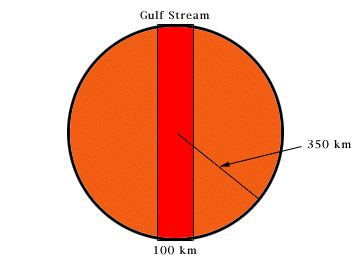
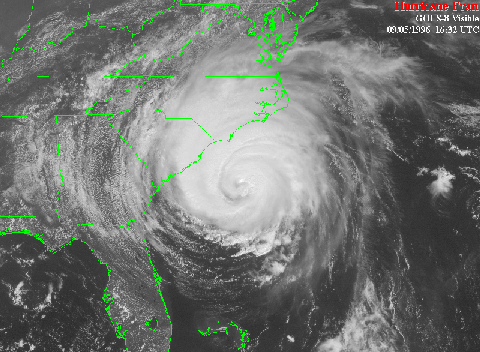
A 7 % increase in latent heat flux is probably an overestimation for most hurricanes. First, the wind speed will not be 100 miles per hour throughout the hurricane. More important than this is the fact that quite often as a hurricane crosses the Gulf Stream, a large portion of the storm is located over land (see below). The hurricane's energy supply is drastically reduced, thus the hurricane loses more energy than it gains, preventing intensification.
 |
||||||||||
 |
 |
|||||||||
 |
||||||||||
| BACK | NEXT | |||||||||
 |
||||||||||