|
Author
|
Topic: New USCG Near Coastal celestial requirements
|
RobertR
|
 posted April 28, 2026 11:40 PM


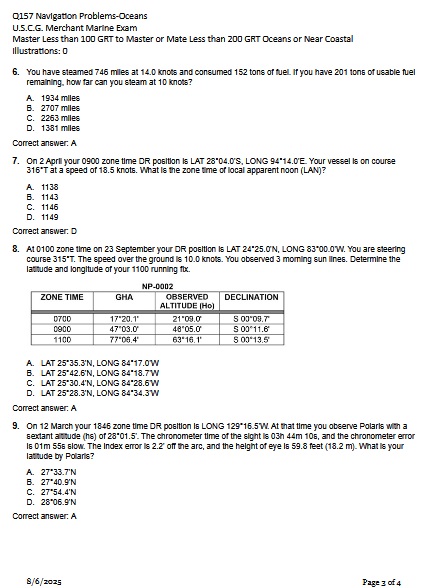
It's been long predicted, but now it appears to be official. USCG license examinations for Near Coastal for 200 gross register tons and less now have the same celestial navigation requirements as Oceans.
This is from the sample Navigation Problems exam on the NMC website as of 28 April 2026, for Master 100 NC, Mate 200 NC and Oceans, and Master 200 NC and Oceans.
Higher tonnage licenses appear to still be split between Oceans (all celestial skills required) and Near Coastal (azimuths, amplitudes, times of sunrise/sunset, latitude and azimuth by Polaris, only).
|
|
RobertR
|
posted April 28, 2026 11:55 PM
Because the sea time and all other requirements for a specific tonnage are already exactly the same for Near Coastal and Oceans, and the only appreciable difference between them was the celestial portions of the Nav Problems and Nav General exams, this effectively eliminates Near Coastal as a license category for this echelon of licenses, leaving only Oceans and Inland as viable route categories.
NMC had previously excluded 100 ton licenses from Oceans endorsements, what that means in this case remains to be seen.
I think it is reasonable to assume that higher tonnage categories will eventually follow suit.
|
|
EReynolds
|
posted May 07, 2026 03:55 PM
So, to be clear, there is still no "Oceans" endorsement for a 100T license? I currently hold a 100t Near Coastal. I do not have the required sea time for the 200t, but it would be nice to have to Oceans option for the 100t. Currently, there is no pathway for a 100t license holder to operate commercially/legally outside 200nm (near coastal), correct?
From: Whidbey Island, WA
|
|
David Burch
|
posted May 07, 2026 04:02 PM
I will let Robert post the definitive answer, but as i recall, you do not need to have the 200T license, you just have to meet the requirements of the license, and if so, you might technically be able to have the endorsement on a 100T license.
From: Starpath, Seattle, WA
|
|
RobertR
|
posted May 08, 2026 10:06 AM
Good morning, captains.
As always with USCG/NMC, "it's complicated."
But there ARE pathways to National Master 100grt Oceans, or at least the functional equivalent.
The first is to simply sit for your Master 200grt Oceans, with a 100grt tonnage restriction.
This requires 1080 days (3 years) total sea service, of which 720 days must have been serving as master or mate while holding a license as master, mate, or OUPV. Of this 1080 days, 270 days (25%) of service must have been on vessels of 51grt or above, OR 540 days (50%) of service on vessels 34grt or above.
Note that for a full (tonnage unrestricted) 200grt master, 50% of the sea service must have been on vessels greater than 67grt, or 25% over 101grt.
So this is the most common path to a "Master 100grt Oceans" license, by any other name. The advantage of it is that the testing is all in the 200grt and less echelon, which is significantly simpler for celestial navigation, and also for Deck General, Deck Safety, etc, than any higher tonnage license.
But there is another path that, other than testing, is quite a bit easier. It is well hidden.
46 CFR 15.901(a)
"An individual holding an MMC endorsed as Mate or Pilot of inspected, self-propelled vessels of 200 GRT or more is authorized to serve as Master on inspected vessels of less than 100 GRT within any restrictions on the individual's MMC, without further endorsement."
There is of course no such thing as a "vessels of 200grt or more" license. So what it means is, Mate 500grt or higher.
So what are the requirements for Mate 500grt Oceans?
720 days (2 years) sea service on deck department on Ocean, Near Coastal or Great Lakes waters, of which 360 days may be Inland. 360 days sea service as Master or Mate while holding an endorsement as Master, Mate, or OUPV. 180 days as Master, Mate, or equivalent position, on vessels of more than 50grt.
Yes, the qualifying tonnage for a 200grt license is 101grt, and the qualifying tonnage for a 500grt license is 50grt. 101grt otherwise qualifies for 1600grt licenses. No, it doesn't make sense, but here we are.
Now, even with a Mate 500grt Oceans license in-hand, the USCG will STILL probably not issue you a Master 100grt Oceans endorsement. But you are then not required to have it in order to legally sail in that capacity.
|
|
RobertR
|
posted May 08, 2026 10:21 AM
Also, not to overstate the obvious, but a Mate 500grt Oceans license opens up a LOT of employment opportunities that are simply not attainable with a 100grt ticket.
|
|
RobertR
|
posted May 08, 2026 11:03 AM
From a USCG testing standpoint, mate 500grt is the same echelon as mate 1600grt, so expect a lot more "small ship" type Deck questions as far as cargo and stability, etc. And a LOT of CFR questions.
For celestial navigation, the main difference between Master 200grt and Mate 500grt is the addition of star sights and star ID and selection with the 2102d Starfinder (Starfinder Book HIGHLY recommended as test prep). Also on the "Nav Problems--Oceans" exam are several oceans "sailings" problems; great circle, mid-latitude, parallel, and Mercator.
|
|
RobertR
|
posted May 08, 2026 04:28 PM
This is an ever-moving target, but as of this afternoon here is a breakdown of celestial navigation techniques tested by the USCG, per license category. These cover Near Coastal, Oceans, Navigation Problems, and Navigation General questions.
==Master and Mate 200grt==
Great Circle Sailing
Mercator Sailing
Amplitude by the Sun
Azimuth by the Sun
Azimuth by Polaris
Latitude by Polaris
Latitude by Local Apparent Noon
Time of Local Apparent Noon
Time of Sunrise/Sunset/Twilight
Hs to Ho, Sun and Stars
Running Fix of Sun, Mid-Altitude
==Mate 500-1600grt, 3rd & 2nd Mate Unlimited==
(in addition to previous items)
Parallel Sailing
Mid-Latitude Sailing
3-Body Fix, Stars Only
2102d Starfinder
---Sight Selection, Stars Only
---Star ID, Navigational Stars Only
==Master 500-1600grt, Chief Mate and Master Unlimited==
(in addition to previous items)
Hs to Ho, Planets and Moon
3-Body Fix, Sun/Moon/Planet
Running Fix of Sun, High-Altitude (Ho > 88°)
2102d Starfinder
---Star ID, Faint Star
==========================
Note that unlike in some previous years, with the possible exception of the high-altitude sun running fix (which is covered in the Emergency Navigation book) and parallel and mid-latitude sailings (covered in Chapter 11 of the textbook), these are all fairly routine techniques used underway, and all are covered either in the Celestial Navigation textbook, the Starfinder Book, or the Emergency Navigation book.
|
|
|



