Some of this is in our textbook, but most is not. Chapter 2 is the background for this subject. Ordinal notes here from 2008, updated Feb 22, 2025
To do celestial navigation, you ultimately need a sextant. You do not need one to complete the course itself, but at some time along the process you will be ready to take sights on your own and may want to get started. As far as scheduling goes, this would not likely occur until after Lesson 3, which covers doing noon sights for latitude. That is our first actual use of a sextant. More general sun sights at other times of day are covered in Lesson 5, which would typically be about 3 weeks into the course at the pace of the online schedule.
The first question that comes to mind in the choice of instrument is plastic versus metal sextant, and that is the first issue primarily because of the cost difference. Plastic sextants range from $120 to $400 and new metal sextants range from $900 to well over $2,000. In the extremes, we are looking at $120 for a sextant or $3,000 for a sextant, which is certainly a broad enough range to want to know the criteria for choosing. There are, however, also rather broad differences in the performance and of use of the two types of sextants, so we cannot make a choice on the basis of price alone.
The dominant factor on choosing metal vs. plastic depends on your goals with learning celestial navigation. This is a rather easy question to answer if you are actually planning an ocean voyage in your own boat and will be responsible for the navigation of the vessel. In this case, you should get a metal sextant, and might as well get it sooner rather than later. Unlike almost everything else which go down in price with time, metal sextants only go up, and they have gone up at a fast clip over the past 10 years or so. Any metal sextant you buy now will be worth more than you paid for it two years from now. We will come back to the issue of $900 versus $2000 later in the talk.
The reason the choice is so simple in this case (i.e. choose metal if you are outfitting your own boat), is because, relative to the overall cost and responsibility of outfitting your vessel, this is a very small factor, and one that could be potentially very valuable… much like a hand-held water maker that costs and weighs roughly the same amount (Survivor 6, from Pur). Metal sextants are simpler to use and significantly more accurate than plastic models. They also have a much higher resale value. In contrast to metal sextants, used plastic sextants are always less than the latest new prices... usually about half or so.
If, on the other hand, your goal of using celestial navigation underway is more in the planning stage, or if you intend to sail with other boat owners (who would most likely have their own metal sextant), then a plastic sextant might be a reasonable option. You will certainly learn from a plastic sextant that celestial navigation all works like it is supposed to and you can become confident that you know how to do it.
The key issue in making this last judgment is a realistic understanding of what the limits are to plastic sextants. In a nutshell, with a plastic sextant (depending on model) you can achieve about 5 miles accuracy in good conditions, whereas with a metal sextant you can routinely achieve under 1 or 2 mile accuracy in most conditions. We have two books that cover the use and role of plastic sextants in great detail: How to Use Plastic Sextants and GPS Backup with a Mark 3 Sextant. We also have this note in our online catalog: About plastic sextants
So the idea is, if you use a plastic sextant, you have to consider a consistent 3 to 5 mile accuracy as proof you are doing it just right, and not worry that you are doing something wrong… indeed, you have to do it precisely as prescribed to get this level of accuracy with a plastic sextant. If you are not getting to this level of accuracy, say you get 10 to 15 miles, then chances are you are not taking the sights in the optimum manner, or perhaps your instrument has some other limitations. (Though still not common, it is more likely that a plastic sextant could have some inherent defect than a metal sextant would.) In other words, if you can achieve a consistent 3 to 5 mile accuracy with a plastic sextant, then you should feel confident that you would achieve consistently under 1 or 2 mile accuracy with a metal sextant.
If you do not have plans to go offshore and actually depend on the instrument for your navigation, then you are left with just the cost factor in your decision. In this sense, it is a quality vs cost issue. The metal sextant gives more accurate results and the process of sight taking is quicker and simpler. But we don't want to over stress this point about quality beyond the accuracy issues already mentioned.
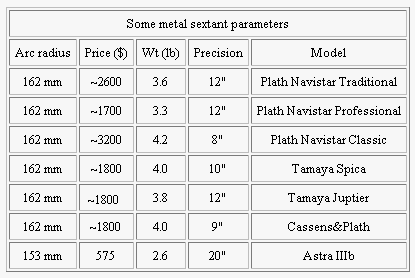
Plastic sextants do indeed work and work well. And you could indeed sail around the world with nothing more than a $120 plastic Mark3 sextant… And on top of that we must make a important distinction here between "simpler to use" and "easier to handle." We said metal sextants have the virtue of being "simpler to use," but this meant that the sights are quicker to take, no special procedures are needed, the index correction is stable, we can get by with fewer sights, they have much better optics so we can take fainter bodies, and so on. When it comes to the actual physical taking of the sights, the plastic sextant is actually much easier to handle simply because it is so much lighter. Even the strongest arm gets tired when holding a 3 or 4 pound sextant at arm's length for even just a minute or two. Hold a half-gallon of milk (4 lbs) up to your nose with one hand for a minute to get a feeling for the effect. (The Astra IIIb is an aluminum alloy sextant that weighs about 2.7 pound, the next step up is a brass alloy Tamaya or Plath instrument that weighs closer to 4 lbs)
So for some users, a plastic sextant could be preferred for just that reason alone. It does not matter at all if an instrument is inherently more accurate if it is too heavy to use. We come back to this weight issue again later on.
As for the issue of which metal sextant, $900 for the Astra IIIb or $1,800 plus for either a Tamaya or Plath instrument, we would have to recommend the Astra. The first and most important reason is you will not do any better navigation at all with a $2000 sextant than you will with the Astra. This is true on land and this is true at sea. This is true from the deck of an aircraft carrier as well as from the deck of a 30-footer going to weather. This is true if you have done 100 sights before or 1000 sights before. Simple as that. Your accuracy at sea at best, in any of the conditions listed, is about 0.5 miles, and the main factors in achieving that accuracy is what sights you take and usually most important, how you correct for the motion of the boat between sights. You will know all about this by the time the course is over. The Astra has more than adequate inherent accuracy to meet this criterion, and each sextant type will also last a lifetime with good care.
That is not to say that there is not a difference in quality. If you look at the Astra beside one of the others, you would have no trouble at all in picking out which one cost $2000 and which cost $900. The more expensive ones are indeed better quality. And they do indeed have better accuracy specifications. But again, this extra accuracy is beyond what we care about in the real ocean—or the real desert or real Arctic. The actual specs of the more expensive instruments are about twice as good as those of the Astra, which is about 20" or so precision along the arc-this is their published value that covers all units sold, but my guess is they are somewhat better than that on the average.
Here is an analogy for the precision specs issue. Suppose your job is to sell apples. You need some form of scales to sell apples. You can buy one set of scales that has a precision of 1 gram for $900 and another set of scales that have a precision of 1 milligram that sells for $2000. Both scales are just as dependable and if you care for them equally they will each last a life time or more. Which then is the logical choice. Your typical apple weighs about 400 grams. In short, an accuracy of 1 gram (one-quarter of one percent accuracy) is all I need to sell apples fairly. In short, the extra accuracy is not an asset in the purchase decision.
Furthermore, the weight difference of 2.7 pounds for an Astra versus 4 pounds for others is a big factor in ease of use. The heavier sextants are harder to use. When your arm gets tired, your sights suffer the pain.
On the other hand, setting aside the ease of use, if someone offered you a Tamaya—Jupiter or Spica—or a Cassens-Plath or some other good looking German or Japanese sextant for anywhere near $900, then you definitely want to consider it. It is likely a high quality instrument and a good investment—if it looks OK, it is probably OK. But this would be a rare find; even used these days these other models are usually in the $900 to $1200 range.
With all this said about models prices, etc, in the end, essentially any metal sextant will most likely do the job. It would be the exception to have a bad one rather than a likelihood. If you find a good deal on one, chances are it is OK. There is a note on used sextants in the Student Discussion Forum. In short, the Astra is a good buy on a dependable instrument, and that choice may be the best if an alternative bargain takes a long time to track down and evaluate. In the end, your knowledge of the process is much more important than the instrument you use. With good knowledge, you could actually make a safe, efficient voyage by cel nav alone with no sextant at all, so long as you have accurate time and an almanac (see our book Emergency Navigation for the details.)
Freiberger is a formerly East German company that makes a sextant model popular in Europe. It is a "drum style" sextant (as opposed to worm gear). There are many of these on the used market. I have no experience with these myself, but they are clearly high-quality instruments. Their yacht sextant model is about $1,000 in the US. At one point we knew personally several folks who did sextant repair for major nav supply outlets. In fact, the 2008 version of this note listed 8 companies in the US. Now in 2021 they are all gone. Ones we knew well, noted that they did not work on Freiberger sextants.
An internal light on a sextant (for reading dials in twilight) is nice convenience, but this can also be solved with a small flashlight worn as a pendant during sight sessions.
Another thought on metal vs plastic. You may not be outfitting your own boat, but might be outfitting your own navigation kit. That is, if you want to make yourself a more attractive crew member, then your knowledge of celestial adds much to the resume. Then you might want a quality sextant to go with your own GPS and VHF radio, and maybe even satellite phone. Combine that with some form of laptop or mobile app with electronic charting and you are a walking nav station, covering both the latest in electronics and the fail safe backup of cel nav. You would then not care what nav equipment is on the boat you go sailing on; you would have a complete set of your own. Just a thought. This type of kit also adds much to your sailing experience on bareboat charters to exotic parts of the world. Generally these vessels are not that well equipped navigation-wise, so with your own kit you get practice at ocean navigation along with your sailing vacation.
Please post your specific questions on sextants and we will do our best to answer.
We have a discussion of mirror types elsewhere in the course.
Reference books on sextants:
Taking the Stars—Celestial Navigation from Argonauts to Astronauts by Peter Ifland. Mariners Museum, Newport News, VA, 1998. Title is misleading, it is not a book on cel nav, but an absolutely beautiful book on the history of sextants. Many color photos. See his sextant history summary.
The Sextant Handbook by Bruce Bauer, International Marine, 1995. Covers all aspects of sextants, including home repairs, various suggestions on sight taking etc.
The Nautical Sextant by WJ Morris. An expert's overview of how they work. In New Zealand. His website is a wonderful resouce on sextants.
Bowditch—chapters on cel nav have much on sextants... in fact all we really need. These chapters are included in the CD version of our cel nav course. Note the earlier versions have more on cel nav than the later. Latest 2002 edition has very little. 1995 has a bit more. Best to go back to 1977 edition, or earlier. 1938 is a good one to find for cel nav… also this is not a rare edition, so it is easy to find used copies at good prices.
Below is the list of prices we had in the 2008 version of this note. Strangely, those few here that are still on the market (bottom 4) have only gone up less than $100 or so, except for the Astra, which is now $900.