How to make a compass, Part 1.
For those who just happen onto this page, these notes are presented in support of proposed ideas in the book Emergency Navigation by David Burch, second edtion available from McGraw Hill in April, 2008. There is an ongoing discussion of emergency navigation topics in the Starpath online Discussion Group.
This first attempt was made from one half of a jumbo paperclip. First shot at making it float was to glue to each end of it one half of a plastic bread bag sealer, which did make it float, but it was purely surface tension and eventually sunk. Once it sunk, it would never float again. Then we switched to gluing it to two thin pieces of dense foam rubber sliced from a sleeping bag mat. This floated very well.
The first pass at this model was a failure. That is, it would float nicely, but would not orient. We also discovered that the floating container should be large as there was otherwise a surface tension attraction to the sides of the bowl. A larger bowl worked better.
The next step was to simply rub the paper clip for a minute or two on the magnet of a fridge magnet. These are not very strong, and a larger speaker magnet might be better. Then we tried again but also with not much better luck. So we left the paper clip on the fridge magnet overnight and tried again in the morning, and then it worked just fine. The pictures and movie are from these tests in the morning.
Note this is the first attempt at this since about 1984 when the emergency nav book was first written. I know we knew more then, and had some stronger working devices, so we need to make more samples. It could be that this is just not the best steel for this purpose. Parts to make these from are everywhere, so we try again and put the results here as well. In any event, this one did indeed orient very well with magnetic north, but we would like to see one a little more responsive for actual use underway.
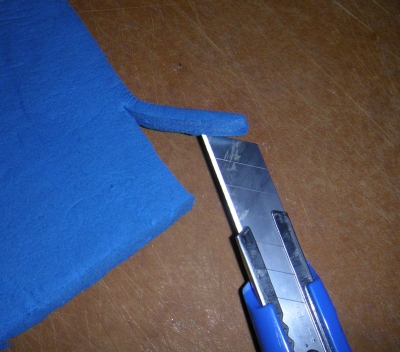
Making the floats |
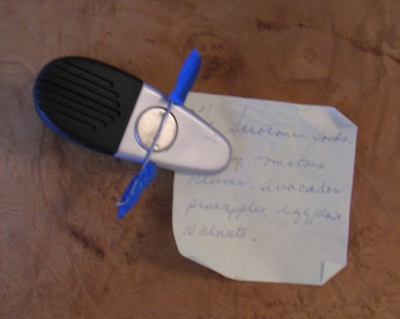
Magnetizing the paperclip overnight |
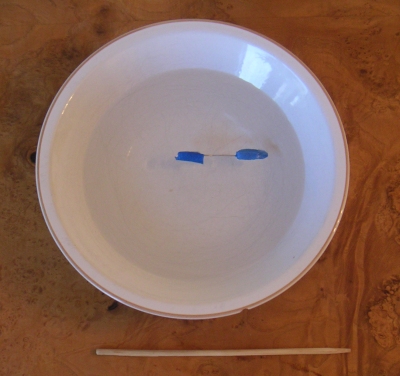
A final position after disturbance |
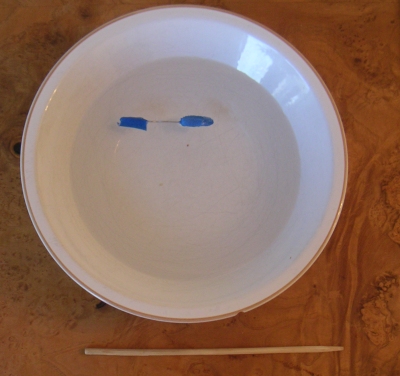
Another final position after disturbance |
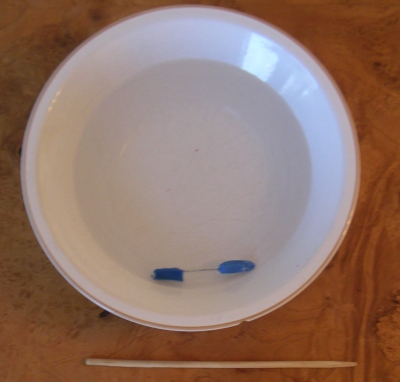
And another, this time locked onto the edges of the bowl |
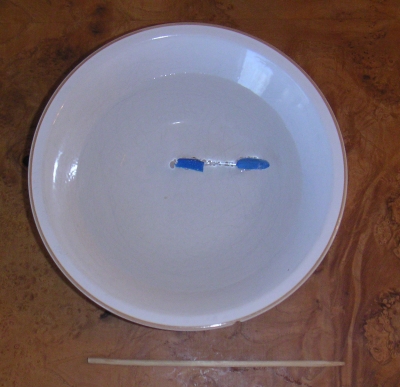
And a final sample of resting position after complete disorientation. |
|
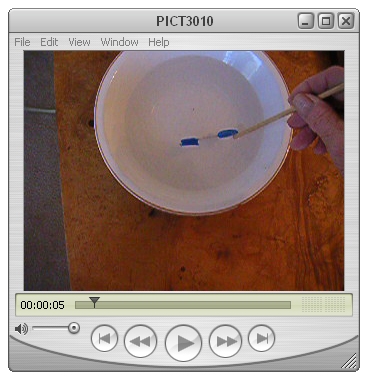
Here is a short clip showing the disturbance
and subsequent orientation.
Click the picture to go to the movie page
Movie has been removed till we can make a smaller version
The movie requires the Quicktime Plugin.
If it does not play you can get the Plugin here. |